Purging in the Time of Pandemic: Physical Stuff

Typically when I write about purging and provide how-to tips, I always recommend trying to sell, donate, or gift unwanted items. However, in the time of pandemic, these types of interactions are being discouraged for safety reasons. While it may be tempting to do some spring clean purging, unless you have space to store items for donating/selling later, extreme times call for a different and more adaptive approach.

So what can I purge? I’m sure some of you are thinking right now.

First of all, electronic items can be purged, organized, and “spring cleaned” any time without leaving your house or sharing anything physical with anyone. I’ll blog more about strategies to get started with electronic stuff in next week’s blog.

Regarding physical stuff, which is typically what people think about with purging, I recommend cleaning out the kitchen and bathroom. These are two areas of our house where products expire. It’s always a good idea to make sure bathroom and kitchen stuff is getting used up before it goes bad.

Since the pandemic guidelines encourage us to limit trips to the grocery stores, this is a perfect opportunity to do a full inventory of the kitchen. Now is the time to pull out those emergency cans of food and dust off the old boxes of pasta. Assess your spice collection. Get creative with what you find. The internet offers a wealth of recipes for whatever ingredients you have on hand.

Learn how to finally cook that bag of hard beans that’s been sitting in your cupboard for way too long. Consider using your available free time to master some new bean recipes. I’m a big fan of refried beans myself. And if you have an Instant Pot, hard beans can been cooked in 35 minutes.

And if cooking isn’t your thing, the bathroom is always a great place to do inventory. Go through all your bathroom stuff and assess what you have. Designate a place to put all the things you want to use up. For example, I found a number of face masks people gave me that I’ll be using for some impromptu spa days in the next few weeks. Inventorying and organizing your bathroom stuff may also save you a trip or two to the drugstore and some money.

I’ve saved lots of money since I re-organized my bathroom. Turns out I was a bathroom hoarder!

Happy purging!
Bring out the Medical Robots

The world was already crazy enough before the pandemic hit. Fast paced, high tech, and an over reliance on social media and technology to replace real, human connection. Once upon a time, and not that long ago, we were encouraged to turn off our devices. Or track our screen time to understand just how addicted we were to technology. It felt strange to make eye contact or, gasp, pick up the phone to call someone.

And now, after being forced into varying degrees of social isolation, many of us are feeling starved for the very thing that we voluntarily replaced with technology, human connection. I’m one of those people. I miss being around people. So it might seem strange that I’m an advocate for medical robots.

Since the beginning of the pandemic, the inability to consistently and accurately test for Covid-19 has been a big problem. Recently we heard on the news that in some places testing would be limited. The primary reason behind this was to preserve the personal protective equipment (PPE) that health care workers are required to wear when collecting the samples. The PPE is in high demand and it’s prioritized to help patients who are gravely ill.

And yet, the testing is critically important to gather the data required to understand what’s really going on. So many questions about the novel coronavirus still remain to be answered, but without data, we can’t really know the whole story. When I heard about the lack of testing, I had a hard time understanding why nobody has built a medical robot to help out with this kind of task.

Why not have robots collecting samples at designated testing sites? Robots can work around the clock, offering services 24/7 which would help to reduce long lines and overcrowding. Robots can be designed to self-disinfect in between every sample. And equally important, robots can be programmed to collect data consistently, eliminating common data entry mistakes.

I don’t write this to diminish the work performed by health care professionals for whom I have an enormous amount of respect, especially nurses. I could never do what a nurse does; I get queasy at the sight of my own blood and even a whiff of diarrhea makes me want to barf. But in cases like this, why not delegate some of the routine, high-risk tasks to a reliable, tireless work source who can’t get infected?

Spring Cleaning, Sanitizers, and Sanity

As so many of us are now in social isolation in an attempt to “flatten the curve” of Covid-19, being cooped up in the same home all day can feel a bit stifling. I always feel especially antsy to get outside and socialize when the sun shines and the weather warms up. But this year is different and requires a new approach.

Once the novelty of binge watching and procrastibaking wears off, this could be a good opportunity to do some spring cleaning and sanitizing. Start chipping away at all those annoying, nagging piles of stuff. Go through your closets, weed out the books you know you will never read, and assess your junk drawer(s). (Note: I love a good junk drawer or three, but it’s a good idea to go through them every once in a while. Read more here.)

I find purging can be a great way to work through many emotions that might be bottled up such as anger, angst, frustration, loneliness, depression, etc. Cleaning after a purge can be a very fruitful and productive way to use up all the anxious energy generated worrying about the virus and the impacts.

Plus, once you purge some stuff, it’ll be easier to establish a quick and easy sanitizing process for the few times you venture out of your house.

All of these things can help you stay sane when you’re in the same place for extended periods of time. If nothing else, you can feel some satisfaction by crossing a few annoying “to-dos” off your list. Or maybe even purge enough stuff that drawers close again. Or find it easier to locate what you need, when you need it.

Use the time now to make space for all the things you want once we can go out again. This applies to electronic spaces, too.

As always, The Deletist has some tips to get started.

  1. Start with something easy – go for the quick wins to build confidence and maintain motivation.
  2. Be elite and delete, save strategically. Define your criteria for what to save/keep and use that to guide you through your purging projects.
  3. If you’re a procrastibaker, make something delicious to munch on while you work.

For more tips and tricks, see my other blogs posts on Spring Cleaning, Productivity, or Deletion. Or order The Art of Making Space: Choosing Quality Over Quantity.

Social Distancing in the Digital Age

Across the globe people are being encouraged to practice social distancing to slow down the spread of Covid-19. In the digital age, this should be easier than ever with so many technological options available. However, a lack of planning, education/training, and glitchy software exposes the flaws in this system. In my experience, this applies to both personal and professional interactions.

I’m a big fan of telecommuting. It can be wonderful for productivity, plus it reduces commute time meaning I’m more rested. When working on contracts as a consult, I was accustomed to working remotely and connecting with clients on an as-needed basis. Some clients, who were not technologically savvy, or more old fashioned, would sometimes require me to appear onsite for meetings. One time I was even flown across the country to present a final report to the Board, which lasted a total of 20 minutes. It was a waste of my time and a lot of money for something that could have easily been accomplished with video conferencing.

Other challenges with working remotely have included things like the technology failing on one side or the other. The issue that always bugged me the most was when employees had the technology installed to connect remotely, but were not trained how to use it. Some months ago I had to call in for a meeting that required screensharing. One of the attendees had never used Skype before and was unable to launch it in time for our meeting.

In general, I find it much easier to connect with people remotely on a personal level, but not as enjoyable. I don’t think it’s because the technology is any easier to use, but perhaps people are more motivated to learn how to use something for personal gain.

While I prefer connecting remotely for work by calling in for meetings, I would rather socialize in person. I’m appreciative for all the ways that technology has enabled me to stay in touch with loved ones who live far away, but it’s not the same as seeing them in person. And I’m not even sure some of my social activities can be replicated digitally, such as playing in an orchestra. And what about people who play team sports?

At least for the next few weeks, we’ll have to adjust to having “virtual visits.”

The Spread of Contagion

As the spread of Covid-19 inches closer towards being declared a pandemic, it’s fascinating to watch the communications. The phrase “going viral” is literally being played out in real time with the threat of an actual virus.

Before people travelled so routinely and often, or through many different available modes, viruses likely spread more slowly. And they were probably easier to contain. Now, it’s easy to see how quickly a virus can spread, similar to how fast something can go viral on social media. People are moving around the globe, traveling faster and more frequently than in previous times. The same is true of information, and its cousins misinformation and disinformation, shooting around the globe in seconds.

In one article I read that each person infected with Covid-19 will pass it to something like 2.2 other people. When I thought about how information is communicated, it seems to me the “viral” spread of messages could be transmitted more generously. Each tweet, post, meme, photo, etc. can be shared with dozens, hundreds, thousands, or even millions of others in a matter of seconds. Imagine if a real virus was this virulent and fast moving. We would be wiped out in no time.

In some ways, it’s impossible to separate the viral aspects of communications from the threat of the real virus, any virus, not just Covid-19. In times of crises, the communications and reporting of such events is critical. It’s imperative for people to understand what is going on, how to prepare or react, etc. from credible and up-to-date resources. However, in the age of social media, it’s easy for the wrong information to be disseminated broadly and accepted as truth. This can make the situation much worse, or give it the appearance of being better than it actually is.

When a crises occurs, it’s common for people to consult sources like the media, credible organizations, or governments for instructions. It’s challenging to know who to trust or follow with so many different messages flying around, trying to keep up with a virus that is likely still under tested and under reported. This is combined with other factors like world leaders who make inaccurate and/or misleading statements. Or governments who try to suppress or censor social media messaging from their citizens and control what gets printed where and by whom. This is the other side of what it means to “go viral.”

Tangible

When I unpacked my father’s Faulkner collection I couldn’t help but notice how enjoyable it was to touch the old books. Books that he had also held in his hands. Or maybe that he read in special places, or in special ways. I enjoy reading and eating, one scenario when an ereader has a distinct advantage over paper because it can be propped up or held with one hand. It’s also much easier to wipe off crumbs. Another favorite of mine is to read  curled up in a comfy chair.

I mostly saw my father reading upright in a chair, often with a fat hardcover book spread across his lap. Or sometimes in bed before falling asleep. I also enjoy reading in bed, but usually when I first wake up. This is one of those times when I prefer paper or the flat screen of an ereader to any other type of screen. 

Although I no longer remember, or think about it, I suspect I probably enjoy reading so much because it was something I did with my parents. A friend of my father’s once told me a story of how I “learned” to read. According to the friend, my father was about to read me a bedtime story. I grabbed the book from him and said, “I’ll read it, Daddy.” He was never sure if I was actually reading or retelling the story from memory, but he was pleased. 

Sharing and reading books with people, especially babies and children, is a wonderfully rewarding experience. A benefit of sharing physical books with little ones is that the books are durable. Even if a book does get destroyed, the damage is limited to one item. If an ereader gets wrecked, the whole library is gone. This is one scenario when paper has an advantage over digital. 

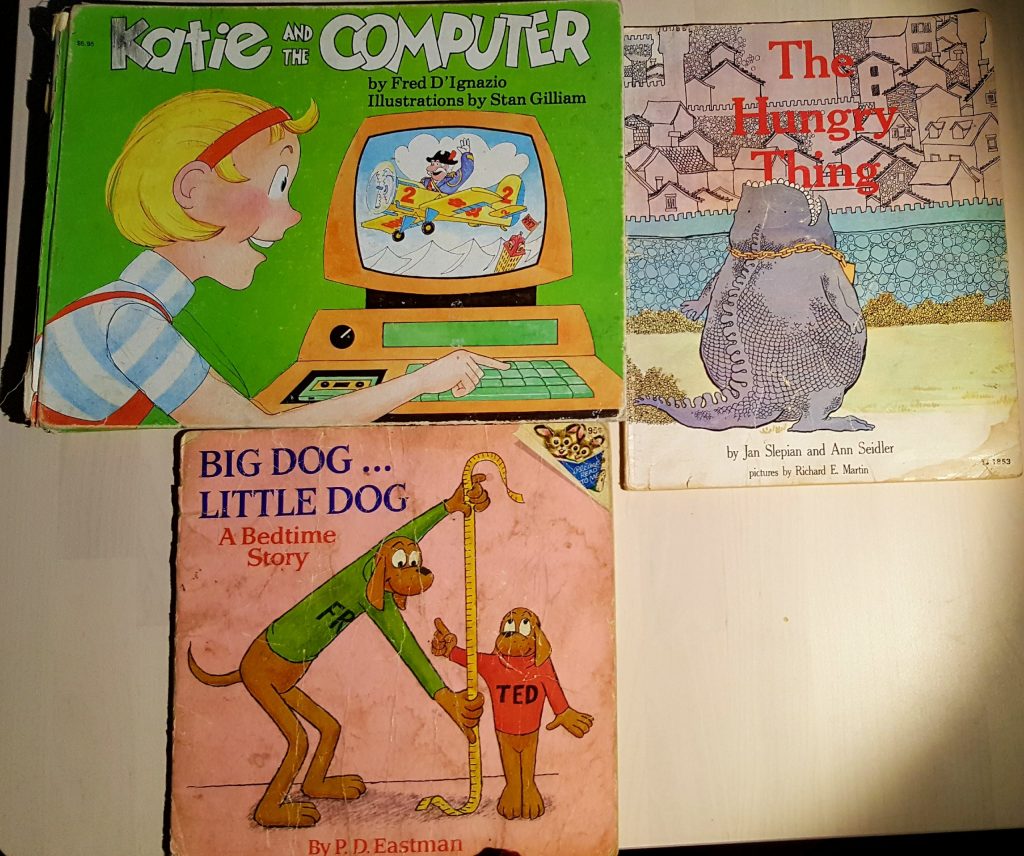
When I was cleaning out my childhood bedroom, I saved a few very beaten up children’s books. The ones with which I had the strongest attachments. When I could still hear my father’s funny voices and comments just by looking at the covers. Yet another advantage of paper books is that they can be owned and opened decades later without anything special, qualities that can’t be replicated so easily in the digital world. Most importantly, they can awaken fond memories, to be be relived or passed on to the next generation. 

Big Dog… Little Dog was one of my father’s favorites. He was still reminding me of its message when I was in my 20’s!