
The Skunk and the Samaritan

About a week ago I scratched my cornea helping to clean my neighbor’s front yard. She’s older and I noticed some pulled plants drying on the front lawn. After bagging those, I was pulling some dead matter from the yucca. While reaching for that last bit, poke! Luckily, not serious.

The following week, when a skunk got trapped in her window well, I had some serious reservations about how far I would go to assist. I felt bad for the animal, but still… skunk spray! After confirming the skunk was, indeed, trapped in the window well, I tried to adjust a basket somebody else had put there. I think it was for the skunk to climb out. However, every time I tried to get close, the skunk pointed her bum at me aiming to spray.

Then I called the City to report the trapped animal. It was a Saturday so I wasn’t sure how long it would take for someone to come. In the meantime, I googled about skunks to give her some food. Learning they eat nuts and fruits, I gently tossed walnuts and a plum into the window well.
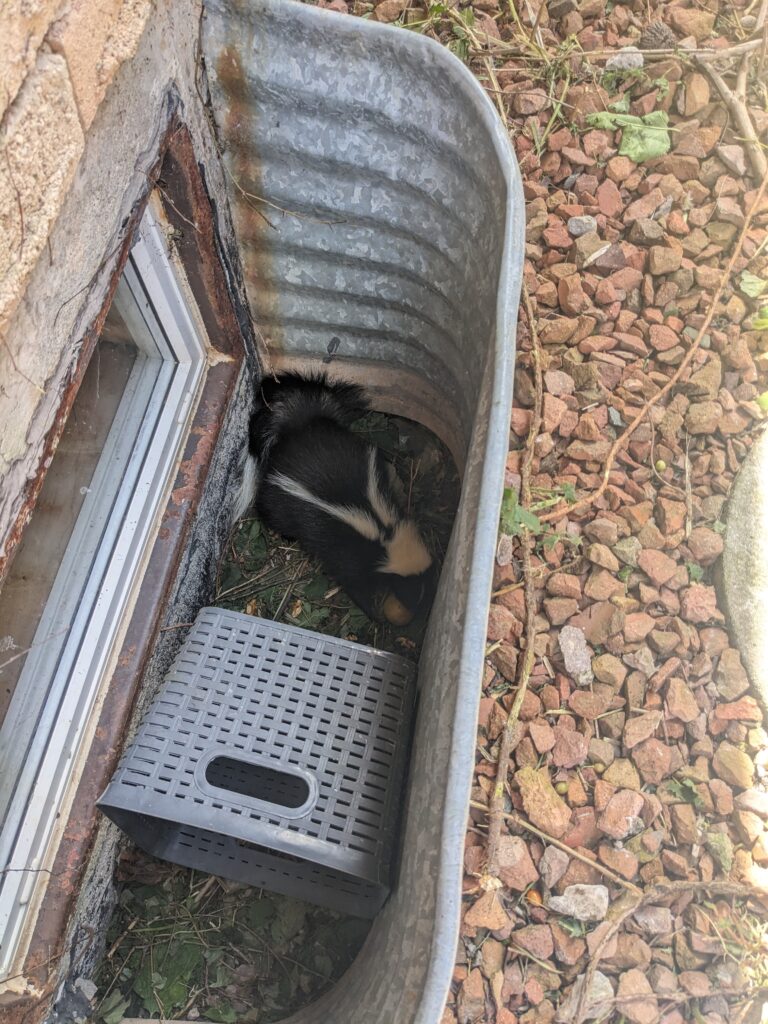
The skunk noisily slurping on a plum. She was definitely hungry! While distracted, I flipped the basket over.

By this time, the City came. Within minutes the animal was freed! I watched the whole rescue. Maybe the most fascinating part was that the city worker only wore a regular pair of latex gloves. No special clothing, no face shield, nothing protective really. The skunk sprayed a lot during the rescue filling the air with noxious, pungent fumes. But luckily, I avoided a direct hit.
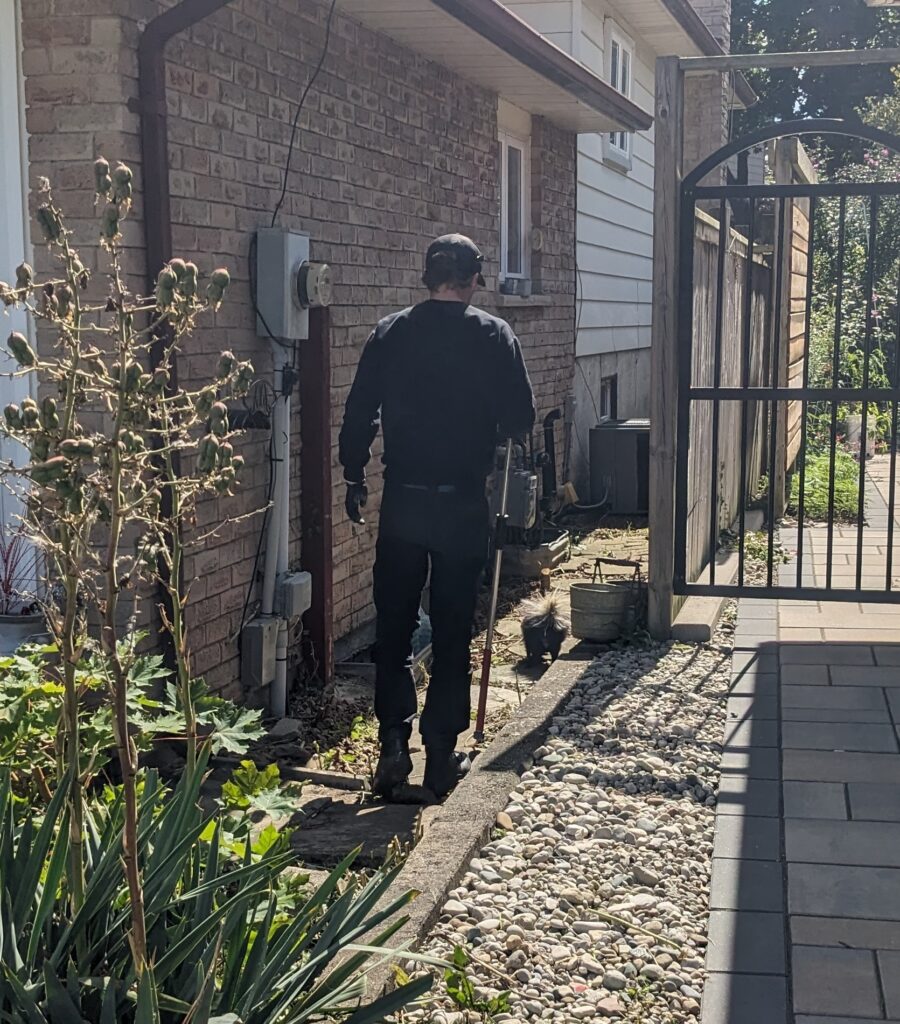
The City worker scaring the skunk away after the daring rescue. She was ready to spray again. Notice the healthy looking, eye-stabbing yucca in the foreground.

What struck me most about this whole situation was that people knew the skunk was trapped in the window well on Thursday. Somehow, I didn’t get this vital piece of information until Saturday. Though I kept wondering why the skunk smell was so strong near the backdoor for days! Once I found out, I immediately called the City to report the trapped animal.

Even if somebody didn’t know to call the City, which I’m assuming nobody did, isn’t this what the internet is for? To connect people to resources? To answer those perplexing questions for an uncommon, surprising situation? And yet, nobody did. Even more puzzling than how the skunk ended up in the window well for over two days, was trying to understand why nobody could connect technology to nature and help this poor animal.


The Seduction of the Subscription Service

Here’s a true confession, I’m still enjoying my AI swim goggles. At first, I only used the goggles for my own personal workouts. Initially, the goggles were really good at showing me exactly how boring my routine workout is! I’ve been doing the same sets for at least 10 years. However, when I signed up for the head-coach subscription service, things started to ramp up.

Signing up for the subscription unlocked basically all the cool features in the goggles. Now I get feedback on many aspects of my swims including:

  • the angle of my head underwater
  • how much I tilt my head when taking a breath
  • how long it takes me to return to a neutral head position after breating
  • how well I pace my self during a set and from one set to the next

In addition to the tracking, the goggles dynamically adjusts workout recommendations based on which skills I need to work on. Everything is customized in real time. The workouts are another huge perk. The goggles provide instructions for my workouts in the display and track everything. I’ve noticed my stats improving in all areas since I paid for the subscription. And that… is the seduction of it.

The subscription is not super expensive at around $120/year, but that’s not the point. The point is that now I’m hooked on it. Without the extra subscription cost, the goggles only function at a basic, minimal level. I’m pretty sure I can’t even upload my own workouts into the goggles without the subscription, thereby reducing the benefits of these expensive, AI-powered goggles.

This is part of a growing trend to provide consumers with devices that need subscriptions to function, or function fully. Naturally, there are pros/cons to this approach. In my entrepreneurial days, everybody was trying to build a subscription service. It’s a way to guarantee steady, sometimes called “passive,” income every month. This can be more reliable than a one-time purchase because it maintains the customer base.

For the consumer, it can make something expensive more affordable. Subscriptions can be monthly, offering smaller amounts. On the other side, this also means the consumer will always be paying monthly, or lose the service. After experiencing the full effects of the subscription service in my goggles, I have to confess it would be hard to let it go. Though benefitting, I’m also committed to the extra payments.

Work Life Boundaries

After the impacts of covid, when more people started working from home, work hours became blurry. At some point they developed a work hours policy at my job. Basically, it allows us to have some flexibility with our work day, provided we’re available from 10 – 3. We’re reminded to be respectful of other people’s working hours, which may not be the same as our own. However, in a world where any hour can be somebody else’s working hours, sometimes it feels as though there are no standards anymore.

This past weekend I filled out an online form for an estimate with two separate companies for a service. When scheduling most things can happen with little to no human interaction, it felt strange to be receiving phone calls. Even more bizarre, both of the phone calls came late on a Sunday night. One was around 8pm and the other after 9pm. The date I requested was for early September, so in my mind, it felt like the phone call could have waited until Monday. And preferably happened at a more reasonable time of the day.

Sometimes it’s easy to forget about boundaries and “respectable” work times in favor of convenience when everything is available all the time. Yet, technology has also prepared us for some of these scenarios. It may seem like a small feature, but I personally love the ability to schedule messages. First of all, I can write and send messages when it’s convenient for me. Then, I can schedule when the message will arrive for the recipient. For example, when my boss is on vacation, I schedule emails to arrive after he returns. My work is done and he can view the messages after he’s settled in. This is a win-win!

I also use this in my personal life when friends are on vacation. Or if I only have time to reply to people late at night. I’m mindful to schedule messages to arrive the next morning to avoid pinging notifications disrupting sleep. In most cases, I’m not looking for an instant reply so the delayed send works well for me, too.

For myself, and my staff, I prioritize work-life boundaries. I encourage people to close computers at the end of the work day and stop checking phone notifications. I remind myself, and employees, to take breaks and enjoy hobbies. When all else fails, use the scheduling feature!

Finding Efficiencies

I’m always amazed at people’s resistance towards recognizing efficiencies. I experienced this first hand when I had my first will drafted about 15 years ago. I hired a lawyer to do the paperwork. However, his process started by giving me a very long, very complicated, form to fill out. The form was clunky and badly formatted. Most of the questions didn’t apply to me, yet, I still had to carefully read each one to make sure I didn’t leave anything out.

The whole time I suffered through this form, I couldn’t help wondering what the lawyer would do with it. The process was terrible. Overly manual and filled with lots of small, important details that were easy to miss in the complexity of the form. When I met with the lawyer, I asked him how he used the form. He explained that he carefully reviewed the multiple times, to make sure he didn’t miss anything. Then transfer the information from the form to the document.

I mentioned there were more efficient and less error-prone ways to accomplish this. Yet, the lawyer told me efficiency wasn’t in his best interests. If something took a long time, it meant there were more opportunities to charge the client for more work. Something about this never sat well with me. I used to be a small business owner, but I would never have used the excuse of charging clients more to be intentionally inefficient. For me, the pain of doing tedious, manual, low-quality work, was incentive enough to streamline my processes.

Similarly, learning that some people in the work place also frown upon efficiencies is surprising. In these scenarios, it’s because they fear losing additional headcount. However, in my opinion, streamlining process and finding efficiencies focuses on quality work. Nobody wants to be copying and pasting information or manually re-entering something because of a bad form. This is garbage work and introduces a lot of errors and re-works into the process.

Efficiencies can often create win-win scenarios. For example, every DIY home project results in multiple trips to Home Depot. Why? Mostly because I don’t gather enough information at the beginning of the project. The fix is easy, spend a few more minutes determining what needs to be done. Measure everything. Go to the store once and buy everything. Then save time with the repair work knowing it’s all ready to go.

the Majestic Monarch

This is year two of my pollinator garden. It’s required real effort. First, I had to eradicate invasive species, mainly goutweed and dead nettles. Though lush and verdant, they took over.

I covered everything in black plastic for weeks to kill the roots. Then my mother worked hard digging up roots and preparing the soil. Finally, we planted a few native species. To be honest, it wasn’t much to look at when summer started. However, I remained optimistic and kept tending to the plants. Slowly it took a shape. Since May, I patrol the patch everyday for invaders, quickly weeding anything invasive.

Over the months I’ve added a new plants, including a milkweed that sprouted like crazy. This is my third attempt with milkweed. Previously, in a different part of the garden, the milkweed always got infested by these horrid, yellow aphids. Each time, after diligently trying to get rid of them, I faced the same inevitable outcome. The plant had to be ripped out. This year, in a new spot, I felt hopeful. However, the invaders came again.

The first bright, specs of aphids infested the flowers and stalks in the front of the plant. I ruthlessly and mercilessly chopped off the affected areas…until the Monarch visit. She fluttered along one day to sample the milkweed’s tasty blooms and lay eggs. I know because after she left I searched the leaves and discovered tiny eggs on some of them. She was elegant, delicate, and completely unhurried in her exploration of the milkweed.

This left me with an uncomfortable dilemma. Save the plant from aphids and risk losing monarch eggs. Or let the aphids proliferate and hope the eggs survive the infestation. I patrol the plant daily squashing any visible signs of aphids. Occasionally I’ll cut the infected parts off, only after inspecting each leaf for signs of monarch life.

In the midst of everything wrong and crazy in the world, the climate, the wars, the air quality… it feels good to preserve a small patch of something. Each day I feel gratitude watching a flurry of winged insects sampling the tasty offerings in my small pollinator patch. Their bodies dusty and speckled from collecting pollen.

I may not be able to save this milkweed from its aphid fate, but I’ve preserved the plant long enough for seeds. And if I’m lucky a few monarchs, too.

The ChatGPT Color Challenge

As part of the renos, we need to pick out new paint colors. I’m notoriously bad at this task. Not only do I feel overwhelmed by the color samples, it’s not something I enjoy. I can’t appreciate nuance in colors and after a while everything starts to look the same. In the past, I’ve faced some harsh criticisms for my color choices, which also make me pretty self-conscious about the whole thing.

Normally I hire my designer friend who is exceptionally skilled with colors for this kind of task. However, there wasn’t time for the consult with the tight deadlines. Feeling a bit lost, I decided to upload a photo of our samples to ChatGPT for some recommendations. Within minutes, a list of 2-3 color options from different color families appeared, along with suggestions for ceiling and trim. For fun, I asked about an accent color for one wall. Within seconds a few options appeared. I tried it a few times until my free account cut off my uploads for a day.

What I appreciated about the experience was getting a few solid starting points. Within minutes, my options were reduced significantly. We still had to compare the sample paint chips with our floor and tile samples in the natural light. However, the task felt less daunting than fanning out options with the color sample book. Even narrowing down to one section in the color sample book still leaves dozens of strips to review.

I felt surprised that ChatGPT also offered to create mockups of the samples I uploaded and the paint color suggestions. However, when I tried this prompt, it took a really long time and nothing ever appeared. Equally annoying was when I reached my maximum amount of uploads, ChatGPT wiped out all the previous recommendations. Luckily, I had been making a list as I went along to see if it was making reasonable suggestions. I also discovered, it picked up too much detail sometimes. I carefully considered the background when uploading photos of the floor and tile samples.

In terms of selection quality, I think my friend would do a better job. I don’t think there’s any danger of ChatGPT replacing interior designers anytime soon. Some things still need that human touch.