
AI’s Overreach

Last week I attended a workshop focused on building an AI strategy. It included a road map, outlining the major considerations and a progression of steps to follow. A highlight included lively conversation with other industry peers. It was affirming and reassuring to hear about others struggling and triumphing with AI.

Usually at these events I walk away overcome by the speed, power, and magnitude AI as a presence in our lives. AI is seeping into everyday things we use. Sometimes we may not even realize it’s there. Other times, we may notice, but there may not be an easy way to disengage. This time, however, I left the event feeling different. Although AI is advancing rapidly, it’s important to focus on the real and tangible ways it’s available and useful to us.

The uses and options for AI are wide, varied, and only limited by our imaginations. However, some of the best benefits are realized by using AI as a humble, assistant. When I started my consultancy, many people advised me that the first position to hire would be an assistant. I never made the leap. If I thought back about that time, part of it was that I didn’t understand how to parse and delegate tasks. I couldn’t separate the mundane, tedious parts of my work eating away at my time and profit margin. It took effort to figure out which aspects of my everyday routine could, in fact, be handled by someone else.

I never did manage to hire that assistant, though I did try a virtual service a couple of times. The service was okay, but the research I needed took a lot of explaining and resulted in subpar results. Now, of course, I could tailor the research myself. AI is available to assist me with a few carefully worded prompts. Within minutes AI can produce similar results to the virtual service and still leave me with the same amount of effort required to review.

Now, older and wiser, I could actually use an assistant. And not for anything grandiose or fantastical. Rather I find AI useful for everyday, mundane tasks. This is especially true for ones I don’t particularly like doing, or can’t manage to find adequate time to focus. Examples include creating meal plans, shopping lists, or even routine email replies. The reach is basic and the results are real.

The Prevalence of AI

It’s impossible to do anything these days without AI. Either somebody is talking about it or you’re interacting with something AI generated. Even more commonly, I’ve started to notice AI prompts appearing. In some places, the AI option remains always visible and ready. Other places, the AI takes a more active role.

Earlier today I realized I forgot to reply to an agency that reached out regarding a new job opportunity a few days ago. The job posting wasn’t a good fit. Replying felt low on my to-do list. I also didn’t want to ignore the email and leave it unanswered. Even though I’m not actively job searching, I always like to keep up the relationships with former employers. In short, I was kind of dreading writing this small reply, even though I knew it would only take about a minute.

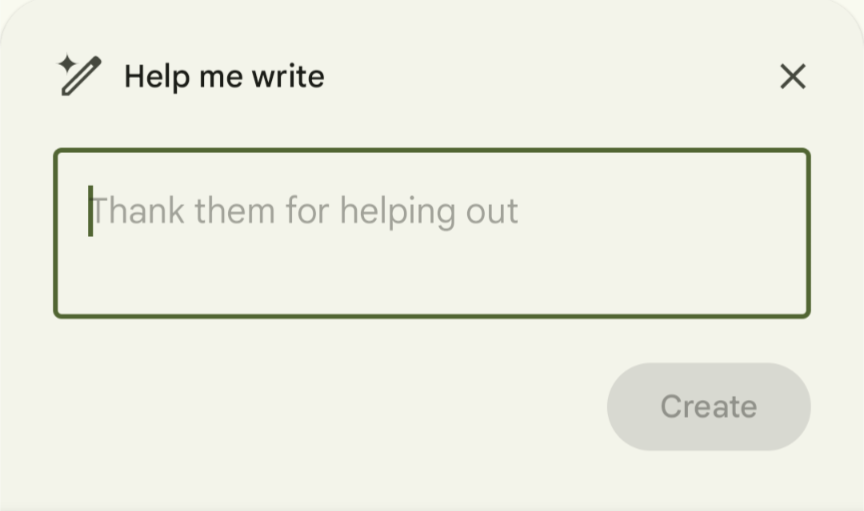
Today, however, when I opened it with the intention of replying, AI swooped in for the win! When I hit reply, a small pen icon appeared with the magic words written in a faint gray font “Help me write” Swipe –>.

I swiped right and a prompt box automatically appeared.

I initially typed in “regrets”, but the prompt needed at least three words to perform. Next, I typed something like “turn down offer.” Almost before I finished typing the “r”, a message appeared politely thanking the agency for the offer before turning it down. I read it, added in a couple lines, and fired it off. Tedious, boring task completed with minimal procrastination! Impressive!

Normally I find AI’s presence obtrusive, most of the time because it’s just there. Often, there’s no obvious way to disable it. Most of the time, there’s no choice about if I even want to engage with AI. This time, however, I felt appreciative for its ease of use and quick, decent sounding reply with minimal effort.

Getting caught up in all the fantastical and futuristic uses for AI is easy. In reality, the biggest impact is likely handling everyday, routine, somewhat boring, tedious things. Low priority tasks that need to be finished, but that nobody wants to do. Though it does make me wonder how our expectations will change to accommodate these new easy, features. Will instant replies be the norm? What if me and the recipient both use automatic AI-replies? Our AIs would have an exchange without our human participation. How weird is that!

Time to Thin it Out

As part of my “Renovation Readiness“, I employed a new strategy. Rather than focusing on getting rid of everything, or keeping too much, I used a different tactic. For this one, I concentrated on reduction. The goal was simple, thin stuff out. In this way, I could trim down what I had without making any hard decisions in a time sensitive situation. Or when energy levels were low, not feel pressured or overwhelmed with too many decisions.

I’ve also found this strategy to be useful with others. Going through a big pile of stuff with a goal of complete organization and resolution can feel daunting. However, switching the mindset to thinning it out a little, alleviates some of those feelings. It helped reduce the pressure to “get it done” and instead reframed the task to “getting some done.” Ultimately, this can be effective for keeping energy moving and maintaining momentum. Although it can create future make-work projects, at least they won’t be as big. Plus the work done to thin something out can also be a good launch pad for the second round or purging and organizing.

I discovered this new tactic provided easy to set goals. For example, instead of going through all my files, I only go through enough so the drawer closes smoothly again. Or all the papers fit in the right folders. There’s no stress to reorganize my entire filing cabinet when I can remove just enough to keep it in good shape. I found it easier to keep moving by focussing on trimming down the overall content to prepare for the renovations.

I still created the same piles with the thin it out strategy. Primarily, shred, toss, donate (or sell), keep. Many loads of things were donated, sold, or given away. We threw out several large garbage bags of trash, unusable, and broken items. Still more papers and boxes made it to the recycling and shred bins. In total, I lost track of how much stuff we thinned out. All I know is that there’s still more to go! But now, I have a new approach to help me through the hard moments. I don’t have to decide everything in one go. I can thin out the current area enough to move on to the next one.

The Impacts of AI

This morning I failed an AI detection test featured in the NYTimes. The quiz included 10 videos, a mix of AI-generated and human-made ones. My goal: correctly determine if AI or a human made the videos. I felt good after the nailing the first four and then things took a turn. I got the next 5 wrong and finally guessed the last one right. Total score, 50%.

AI-generated videos are getting much harder to detect. The small glitches and weird imperfections, telltale marks of AI, are largely undetectable. The technology has improved rapidly. Also, AI trains on real recordings, making it possible to create something new from an existing persona. All of these factors combined make it increasingly more difficult to detect fact from fiction.

On the flip side, technology has also improved the capabilities of making films and movies. In some cases, AI may even be used on the backend to expedite editing or creating effects, even though the main content is real. Sometimes AI is used to fill in missing elements or add something to the background that wasn’t there initially. This also blurs the line between AI-generated and human made. I suppose at a certain point, we’ll consider the percentage of a work made by humans vs. AI to determine creation.

Another huge impact of AI is more on the environmental side. AI generating centers require huge amounts of space, time, resources, and energy to maintain. As more of us start using AI, or rely on devices using it, this creates more demand for the centers. The location of these centers and their management also creates impacts. Living in Canada, we’re mindful in which country our Canadian resides. This can create challenges and concerns about data management and under which jurisdiction. For example, the privacy laws in the US are different from those in Canada.

All of this to say, the lines are blurring.

Renovation Readiness

In two weeks major renovations will be starting in my home. Since it’s hard for me to simply throw stuff in the garbage if I no longer want or need it, it takes a lot of effort to move things out. Clean up efforts included purging, selling things, recycling, shredding, and donating lots of stuff. Some stuff even requires specialized donations, which can take time to locate. For example, I had a box of broken jewelry that I felt guilty about tossing in the trash. One day I randomly saw a post on FB marketplace for someone “ISO” (in search of) old jewelry. Even better, this person was in my neighborhood. Score!

I started preparing for the work in Jan, even before I had called any contractors or received a single estimate. The scope of work remained undefined. But already I knew that it would require a big clean up effort. Slowly, over weeks and months, I’ve been spending small amounts of time working through everything. Sometimes I spend 20 minutes on one shelf in the evening after a day of work. Other times it’s a few hours spent on larger areas. It also included clean-up efforts in other parts of the house, and in the garage, to make more space.

By spacing it out over months, instead of a helter-skelter rush in the weeks preceding the demolition, I was hoping to avoid “make-work” projects for myself. These typically occur when the fatigue sets in and the time crunch starts. It’s when good decisions evaporate because things need to happen fast. This is when things get randomly thrown together in boxes with a self-promise to clean it later. However… nearing the final weeks of a months long process, everything is devolving into future work projects, despite my best efforts.

Things are getting messy in the packed boxes, and in the available areas in the house where we are storing everything. The basement, one of the renovated areas, will have shiny, new storage cabinets. While I’m looking forward to the new, storage spaces, I’m also dreading it slightly. Nature hates a void and I’m concerned I’ll find creative ways to fill the space. This after spending so many months and so much effort to thin out years of accumulation. It won’t happen right away because I’ll be busy with my “make-work” future projects enjoying the results of all the hard work.

Grief’s Humanity

June is always a bit hard for me. In quick succession my father’s birthday, father’s day, and the deathdays pass. Along the way other memories flit in and out, such as the day my father went to hospice, the last time I heard him speak, and the last time he said my name. All in June.

During the final weeks and days, I would have given almost anything for one more day. Even if it was a bad one. I knew my father was in terrible pain, but I still wanted him alive. His condition and suffering was secondary to my wants. For years after the yearning was intense. The desperate feelings I had to hear his voice, call him, or laugh at his nerdy math jokes. We left his voice on the answering machine for a long time. Some days I would call and hang up after hearing the message, repeatedly. I felt it was the closest link I had.

Over time, along with various therapies and techniques, I learned how to process the enormous grief I felt. I developed ways to cope with the intensity of the emotions. The yearnings are still there, but I relate to them differently. I can transport myself to the intensity of the experience in an instant, but I know how to deal with it now. It’s all part of the grieving process, a natural part of being human.

However, now different options are available, ones that will undoubtably impact how we grieve. What that impact will be is unknown. This June marks 22 years since my father, and grandfather, died, only one day apart. Had they passed away only two years ago, I would have had a plethora of media available. Videos, digital photos, recordings, maybe even some social media postings. All of this would have provided me with more opportunities to see and hear my father posthumously. Now there are even options to create AI avatars of your loved one to continue the conversations even after they are no longer around.

I can’t help but wonder how this will affect the natural progression of grieving. My initial grief was extreme and I would have loved these AI-options. But in hindsight, I’m not sure if having it might have kept me in grief-limbo or helped me to move forward. After all, grieving is part of what makes us human.